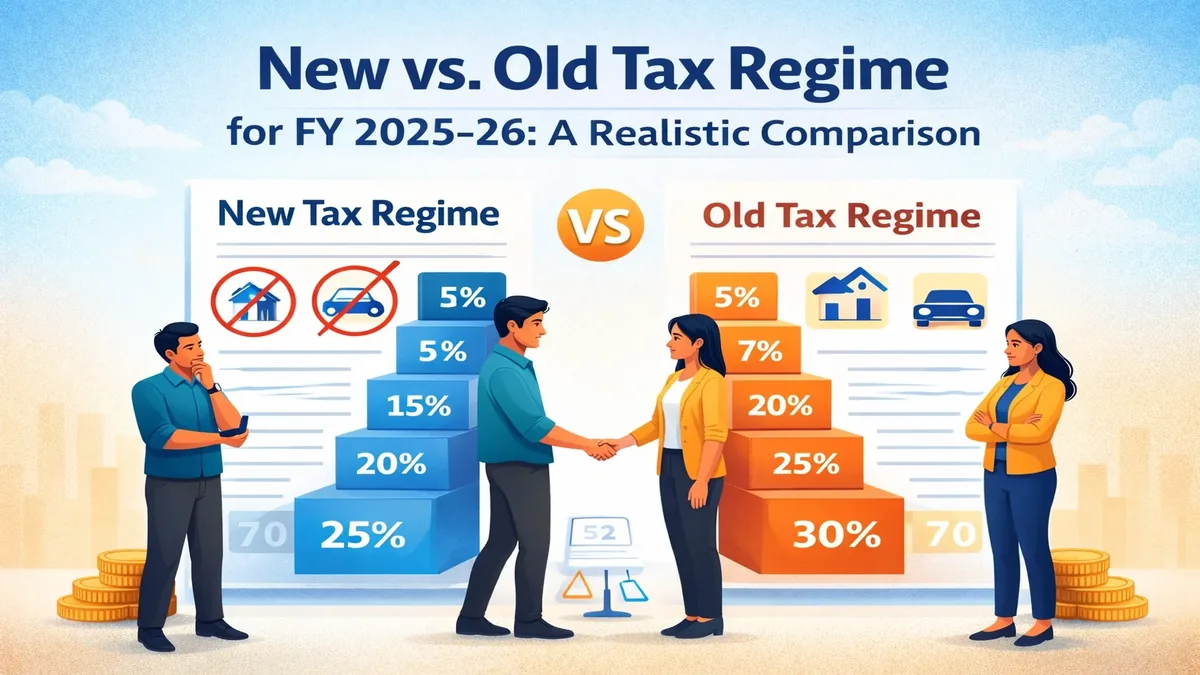
The question "which tax regime should I choose?" has a different answer in FY 2025–26 than it did two years ago. Budget 2025 made the new regime far more attractive — with zero tax on income up to ₹12.75 lakh for salaried individuals. But the old regime is not dead. For the right taxpayer profile, it still saves more money. Here is exactly how to figure out which side you fall on.
What Changed in FY 2025–26: Budget 2025 in Brief
The Union Budget 2025, presented on February 1, 2025, introduced the most significant overhaul to the new tax regime since its launch in FY 2020–21. The changes were specifically designed to make the new regime the obvious choice for the majority of taxpayers.
Three changes matter most for your decision:
- Revised slab rates: The nil-tax threshold under the new regime was raised from ₹3 lakh to ₹4 lakh, with lower rates across multiple brackets.
- Enhanced Section 87A rebate: The rebate was increased to ₹60,000 for individuals with total income up to ₹12 lakh, effectively making income up to ₹12 lakh completely tax-free under the new regime.
- Standard deduction retained: The ₹75,000 standard deduction for salaried employees was retained, pushing the effective zero-tax threshold to ₹12.75 lakh for salaried individuals.
Key point: The new tax regime is the default regime from FY 2024–25 onwards. If you do not actively opt for the old regime, the new regime applies automatically. You must file Form 10-IEA to opt out.
New Tax Regime: Slabs, Standard Deduction, and the Zero-Tax Benefit
The new tax regime offers lower slab rates with no deductions or exemptions (except the standard deduction for salaried individuals and pensioners). It is designed for simplicity — no investment planning required.
New Tax Regime Slab Rates for FY 2025–26
| Income Slab | Tax Rate |
|---|---|
| Up to ₹4,00,000 | Nil |
| ₹4,00,001 to ₹8,00,000 | 5% |
| ₹8,00,001 to ₹12,00,000 | 10% |
| ₹12,00,001 to ₹16,00,000 | 15% |
| ₹16,00,001 to ₹20,00,000 | 20% |
| ₹20,00,001 to ₹24,00,000 | 25% |
| Above ₹24,00,000 | 30% |
4% Health and Education Cess applies on the tax computed above. Surcharge applies for income above ₹50 lakh as before.
For salaried individuals: after deducting the ₹75,000 standard deduction, a gross salary of up to ₹12.75 lakh results in a total income of ₹12 lakh or less — fully covered by the Section 87A rebate. Tax payable: zero.
What you cannot claim under the new regime:
- Section 80C deductions (PPF, ELSS, LIC, EPF contribution, home loan principal)
- Section 80D (health insurance premiums)
- Section 24(b) (home loan interest)
- HRA exemption
- LTA exemption
- Section 80CCD(1B) (additional NPS contribution)
- Most other Chapter VI-A deductions
Old Tax Regime: Deductions That Still Make It Relevant
The old tax regime has higher slab rates but allows a broad range of deductions and exemptions. For taxpayers who have structured their finances around these deductions, it can still result in lower tax outgo than the new regime.
Old Tax Regime Slab Rates for FY 2025–26
| Income Slab | Tax Rate |
|---|---|
| Up to ₹2,50,000 | Nil |
| ₹2,50,001 to ₹5,00,000 | 5% |
| ₹5,00,001 to ₹10,00,000 | 20% |
| Above ₹10,00,000 | 30% |
The key deductions available under the old regime that can substantially reduce your taxable income:
- Standard deduction: ₹50,000 for salaried employees and pensioners.
- Section 80C: Up to ₹1,50,000 (PPF, ELSS, EPF, LIC premium, NSC, home loan principal, tuition fees).
- Section 80D: Up to ₹25,000 for health insurance (self and family) + ₹25,000 for parents (₹50,000 if parents are senior citizens).
- Section 24(b): Up to ₹2,00,000 on home loan interest for self-occupied property.
- Section 80CCD(1B): Additional ₹50,000 for NPS contributions, over and above 80C.
- HRA exemption: Varies based on salary, rent paid, and city. Can be substantial for metro residents.
- Section 80TTA/TTB: ₹10,000 on savings account interest (₹50,000 for senior citizens under 80TTB).
Maximum deductions most individuals can claim (excluding HRA): approximately ₹4.25 lakh (₹50K standard + ₹1.5L 80C + ₹50K 80D + ₹2L 24b + ₹50K NPS 80CCD(1B) + ₹10K 80TTA). With HRA, the total can go significantly higher.
New vs. Old Tax Regime: Head-to-Head Comparison
| Parameter | New Regime | Old Regime |
|---|---|---|
| Default regime? | Yes | No (opt-in required) |
| Zero-tax limit (salaried) | ₹12.75 lakh | ~₹7 lakh (with 80C + 80D) |
| Standard deduction | ₹75,000 | ₹50,000 |
| Section 80C (₹1.5L) | Not available | Available |
| Section 80D (health insurance) | Not available | Available |
| Home loan interest (Sec 24b) | Not available | Up to ₹2 lakh |
| HRA exemption | Not available | Available |
| NPS (Sec 80CCD(1B)) | Not available | ₹50,000 additional |
| Slab rates | Lower (5%–30%) | Higher (5%/20%/30%) |
| Complexity | Simple | Requires investment planning |
| Best for | Most taxpayers in 2026 | High deductions + home loan + HRA |
Realistic Tax Calculations at Key Income Levels
The following scenarios are for salaried employees. Old regime calculations assume maximum practical deductions: 80C (₹1.5L), 80D (₹50K including parents), NPS 80CCD(1B) (₹50K), and home loan interest 24(b) (₹2L where applicable). All figures include 4% cess.
At ₹8 Lakh Annual Income
| Regime | Taxable Income | Tax Payable (incl. cess) |
|---|---|---|
| New Regime | ₹7.25L (after ₹75K std. deduction) | ₹0 (87A rebate) |
| Old Regime | ₹5.5L (after deductions) | ₹28,600 |
Verdict: New regime wins by ₹28,600. There is no scenario at this income level where the old regime is better.
At ₹12 Lakh Annual Income
| Regime | Taxable Income | Tax Payable (incl. cess) |
|---|---|---|
| New Regime | ₹11.25L (after ₹75K std. deduction) | ₹0 (87A rebate) |
| Old Regime (max deductions) | ₹9.25L | ₹1,01,400 |
Verdict: New regime wins by over ₹1 lakh. Budget 2025's enhanced rebate makes this the biggest no-brainer in FY 2025–26 tax planning.
At ₹15 Lakh Annual Income
| Regime | Scenario | Tax Payable (incl. cess) |
|---|---|---|
| New Regime | Standard deduction of ₹75K | ₹97,500 |
| Old Regime (no home loan, no HRA) | 80C + 80D + NPS | ₹1,87,200 |
| Old Regime (with home loan + HRA of ₹1.5L) | All deductions maxed | ₹88,920 |
Verdict: Mixed. Without HRA and home loan, new regime saves nearly ₹90,000. With both, old regime saves about ₹8,600. The margin is thin — home loan plus meaningful HRA is the tipping point at ₹15 lakh.
At ₹20 Lakh Annual Income
| Regime | Scenario | Tax Payable (incl. cess) |
|---|---|---|
| New Regime | Standard deduction of ₹75K | ₹1,92,400 |
| Old Regime (all deductions + HRA ₹2L) | Taxable income: ₹12.75L | ₹2,02,800 |
| Old Regime (no HRA, max other deductions) | Taxable income: ₹14.75L | ₹2,65,200 |
Verdict: New regime wins in most cases. Even with maximum deductions and a ₹2L HRA benefit, old regime is marginally more expensive. Only with significantly higher HRA exemption (₹3L+) does old regime gain a real edge here.
At ₹30 Lakh Annual Income
| Regime | Scenario | Tax Payable (incl. cess) |
|---|---|---|
| New Regime | Standard deduction of ₹75K | ₹4,75,800 |
| Old Regime (all deductions + HRA ₹2L) | Taxable income: ₹22.75L | ₹5,14,800 |
| Old Regime (all deductions + HRA ₹4L) | Taxable income: ₹20.75L | ₹4,51,360 |
Verdict: Old regime wins only with very high HRA. At ₹30 lakh income, you need an HRA exemption of approximately ₹4 lakh or more for the old regime to outperform. This typically means metro cities with high rents and a significant HRA component in salary.
Important: These calculations are indicative based on standard assumptions. Your actual tax depends on your specific salary structure, HRA entitlement, actual investments, and city of residence. Always calculate both regimes with your actual figures before deciding.
"Budget 2025 has made the new regime the right default for most taxpayers in India. The old regime is not irrelevant — but you need concrete numbers to justify staying with it, not assumptions."
Aman Mishra, Chartered Accountant
Who Should Stick with the Old Tax Regime
The old regime is worth considering only when the deductions you can genuinely claim are large enough to bring your taxable income down significantly below what the new regime rates would produce.
You are a strong candidate for the old regime if you meet most of the following:
- You have an active home loan with annual interest payment close to or at the ₹2 lakh limit.
- You receive substantial HRA and pay significant rent (typically metro residents with rent above ₹20,000 per month and HRA forming a large part of your CTC).
- You have maxed out 80C investments (EPF + PPF or ELSS + LIC) reaching the full ₹1.5 lakh limit consistently.
- You contribute to NPS under Section 80CCD(1B) for the additional ₹50,000 deduction.
- Your income is above ₹15 lakh. Below ₹12.75 lakh, the new regime is almost always better.
- You pay health insurance premiums for yourself and senior citizen parents (combined 80D deduction of ₹75,000).
If you can claim deductions totalling ₹5–6 lakh or more (home loan + HRA + 80C + 80D + NPS), the old regime may still win at incomes of ₹20–30 lakh. Run the numbers with your actual figures.
Who Should Choose the New Tax Regime
The new regime is clearly better for the following profiles in FY 2025–26:
- Salaried individuals earning up to ₹12.75 lakh. Zero tax is available — there is no combination of old regime deductions that can compete with a complete tax exemption.
- Young earners without significant investments. If you have not yet maxed 80C or set up a home loan, the old regime offers limited benefit. The new regime's lower rates are straightforwardly better.
- Individuals in rented accommodation in non-metro cities where HRA exemption is modest (40% of basic salary).
- Self-employed professionals and business owners who want to simplify their tax structure. Under the new regime, you still cannot deduct business expenses, but the lower marginal rates can be beneficial.
- Taxpayers who find investment-based tax planning restrictive. If you prefer liquidity over locking money in PPF or insurance, the new regime lets you invest freely without a tax penalty.
- Pensioners and senior citizens with income between ₹7.5 lakh and ₹12 lakh who may not have significant deductible investments.
How to Switch Between Regimes
Understanding the switching rules is as important as choosing the right regime. The rules differ for salaried employees and those with business income.
For Salaried Employees
- You can switch between regimes every year at the time of filing your income tax return.
- Inform your employer at the start of the financial year to ensure TDS is deducted under your chosen regime. Employers typically ask for this declaration in April.
- If you miss informing the employer, you can still switch when filing your ITR. Any excess TDS will be refunded.
- To opt for the old regime, file Form 10-IEA before the due date of return filing (July 31 for non-audit cases).
For Individuals with Business or Professional Income
- If you have income from business or profession, you can switch to the old regime only once in a lifetime. Once you leave the new regime as a business taxpayer, you cannot return to it.
- This is a critical distinction. Business owners must plan this carefully before making the switch.
- File Form 10-IEA before the ITR due date to exercise or withdraw the option for the old regime.
Important reminder: If you do not explicitly opt for the old regime, the new regime applies by default. Salaried taxpayers who want to claim 80C, HRA, or home loan deductions must actively opt out of the new regime every year.
Frequently Asked Questions
Is the new tax regime always better in FY 2025–26?
For incomes up to ₹12.75 lakh (salaried), yes — the enhanced Section 87A rebate results in zero tax, which no deduction strategy under the old regime can match. Above that threshold, it depends on your actual deductions. The old regime can win for high-income individuals with home loans, significant HRA, and all major deductions maxed out.
I have a home loan. Should I still consider the new regime?
Yes, unless your home loan interest is close to the full ₹2 lakh deduction limit. At income levels below ₹15 lakh, even with a home loan, the new regime often results in lower tax. Calculate both options with your actual numbers before deciding.
Can I claim 80C deductions under the new regime?
No. Section 80C and most Chapter VI-A deductions are not available under the new regime. The only deduction available to salaried employees under the new regime is the ₹75,000 standard deduction. The employer's contribution to NPS under Section 80CCD(2) is also allowed, which is relevant for those whose employer contributes to NPS on their behalf.
What is the last date to choose a tax regime for FY 2025–26?
For salaried employees: inform your employer at the start of the year (April 2025 for FY 2025–26) for correct TDS. You can revise your choice when filing the ITR by July 31, 2026 (non-audit cases). The formal option is exercised by filing Form 10-IEA. If you miss this, the new regime applies by default.
Can a freelancer or self-employed individual choose between regimes?
Yes, but with a restriction. Self-employed individuals and business owners can switch back to the old regime only once. Once they return to the old regime and then opt out again, they cannot go back to the old regime. Salaried individuals have no such restriction and can switch freely every year.
Is the Section 87A rebate available under both regimes?
Section 87A is available under both regimes, but the quantum differs significantly. Under the new regime for FY 2025–26, the rebate is ₹60,000 for income up to ₹12 lakh. Under the old regime, the rebate is ₹12,500 for income up to ₹5 lakh. This difference is central to why the new regime is more attractive for mid-range incomes.
Key Takeaways
- Budget 2025 made income up to ₹12.75 lakh completely tax-free for salaried individuals under the new regime. At this income level, the old regime cannot compete.
- The old regime still wins for high-income taxpayers (₹20L+) who have a home loan, substantial HRA in metro cities, and all major deductions (80C, 80D, NPS) maxed out.
- The new regime is the default. If you want the old regime, you must explicitly opt in by filing Form 10-IEA before the ITR due date. Missing this means new regime applies automatically.
- Never choose a regime based on generic advice. Calculate both options with your actual salary structure, investments, and deductions every year before April.
Conclusion
The new tax regime is no longer just a simplified alternative — in FY 2025–26, it is the better option for the large majority of salaried taxpayers in India. The zero-tax benefit up to ₹12.75 lakh is a significant policy shift, and ignoring it can cost you money.
That said, the old regime is not obsolete. If your salary is above ₹15 lakh, you live in a metro and pay significant rent, you have an active home loan, and your investments are structured around 80C and NPS, run the numbers carefully. The difference may favour the old regime in your specific case.
The right answer is not "new regime" or "old regime" in the abstract. It is the regime that produces a lower number when you apply your actual income and actual deductions. If you are unsure, our team can calculate both options for your specific situation and help you make an informed decision before the deadline.
Aman Mishra
Chartered Accountant · Mishra Aman & Company
Aman Mishra is a Chartered Accountant with expertise in Indian and UAE taxation, audit, and financial advisory. He advises businesses on GST compliance, corporate structuring, and cross-border tax matters.